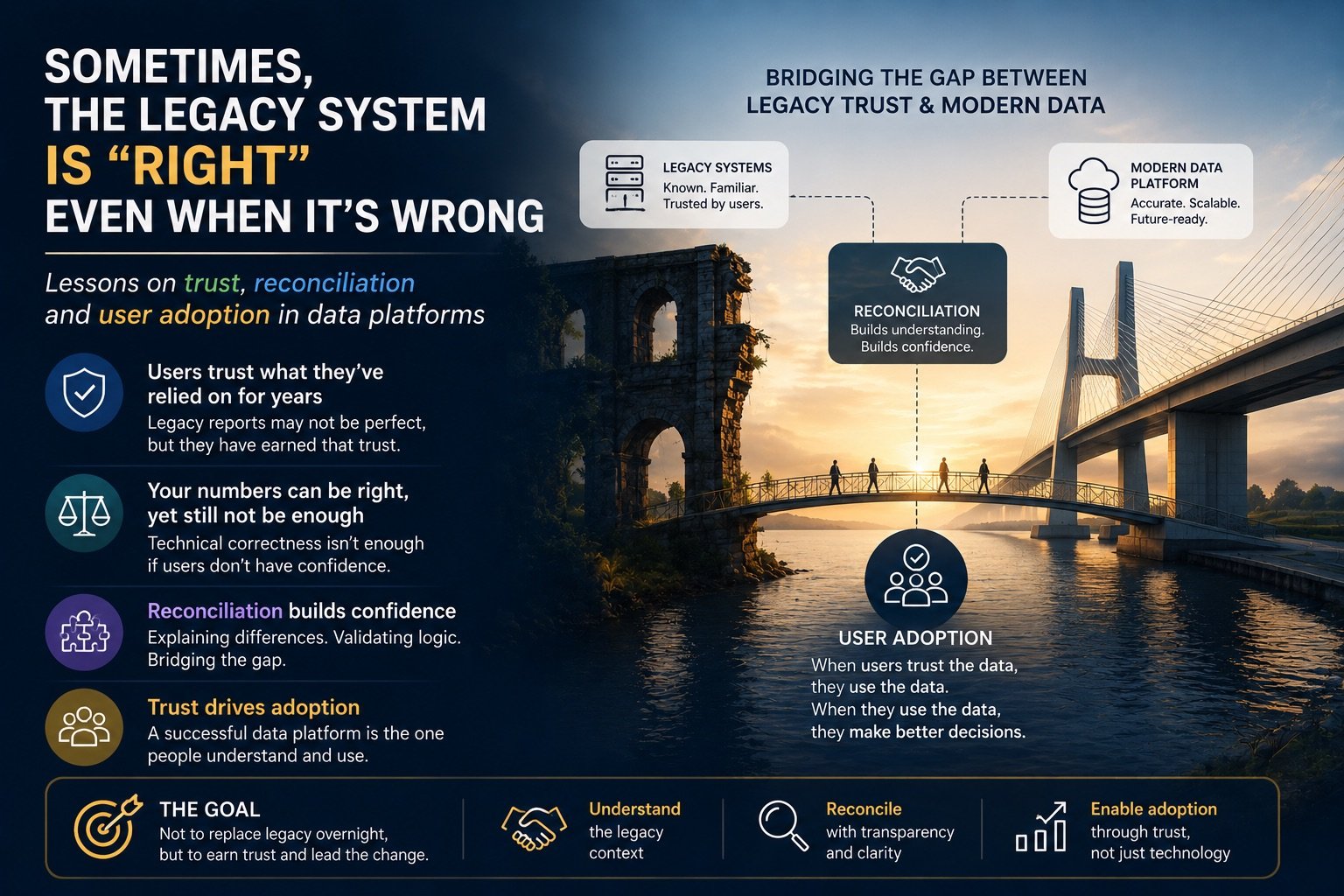
One of the hardest lessons in enterprise data architecture has nothing to do with technology. It's about trust.
Imagine you've built a modern data platform. Your pipelines are automated. Your calculations are accurate. Your validation checks pass. But business users compare your numbers with a 15-year-old legacy report — and the numbers don't match.
The instinct is often: "our system is correct." Technically, that may be true. But from a business perspective, it doesn't matter. Users trust the legacy system because it has supported their decisions for years.
Why "technically correct" isn't enough
A platform can pass every data quality check and still fail — if the people who are supposed to use it don't believe the numbers. Trust isn't a side effect of good architecture. It's a requirement for adoption, and it has to be designed for just as deliberately as the pipelines themselves.
What reconciliation actually looks like
In one project, we invested significant effort in data reconciliation against legacy reports before introducing new dashboards. Not because the legacy logic was perfect — but because user confidence was more important than technical correctness in the short term.
Once users understood these three things, they became comfortable adopting the new platform:
- Why differences existed
- Which business rules had changed
- How reconciliation worked
Architecture creates capability. Trust creates adoption.
Those are two different jobs, and both are the architect's responsibility. It's easy to optimize for the first and assume the second follows automatically. It doesn't — and skipping it is usually what turns a technically sound platform into one nobody actually uses.