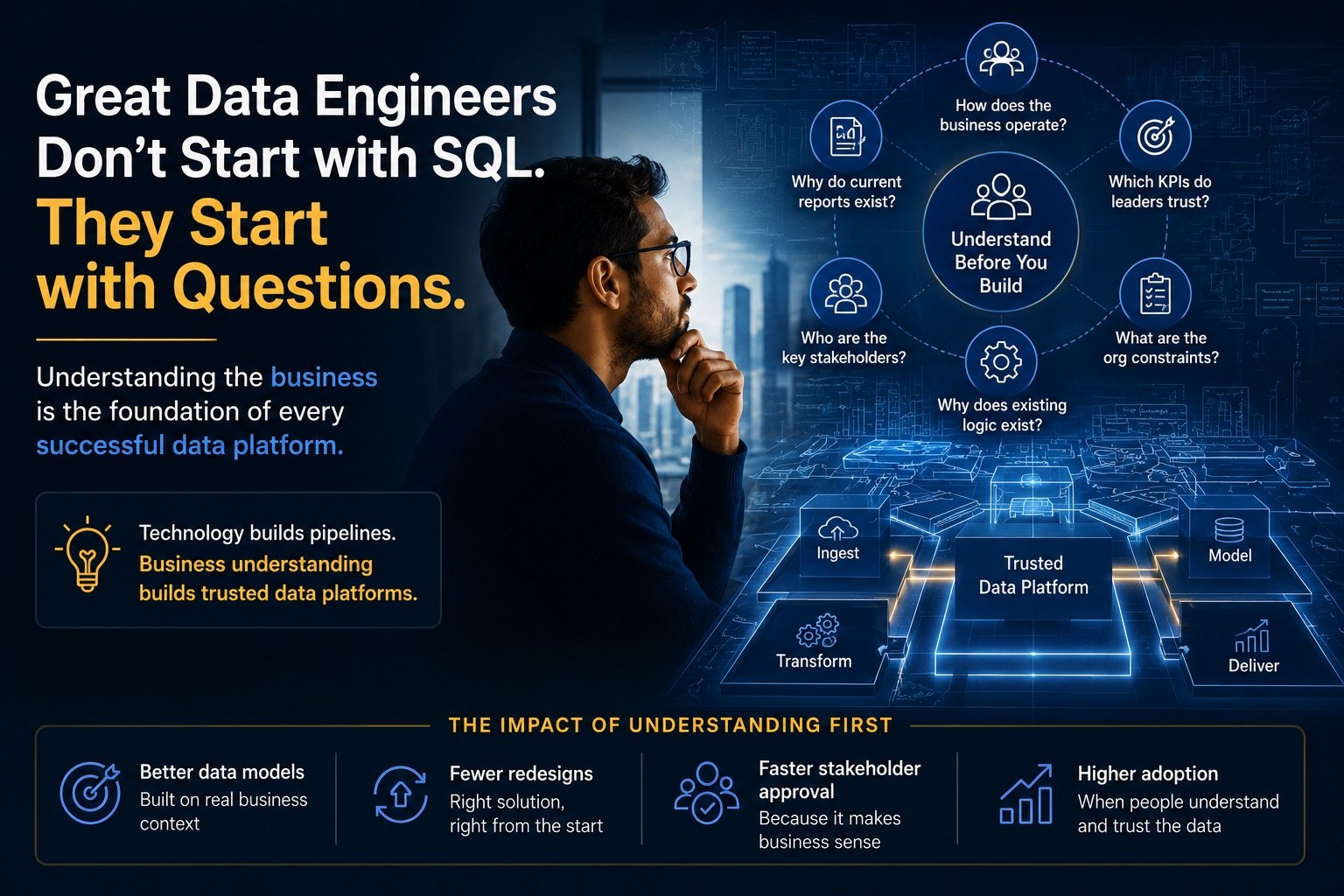
One lesson I've learned while working on enterprise data platforms is this: the best data engineers don't start with SQL. They start with questions.
When I first moved into larger enterprise projects, I assumed success meant building scalable pipelines, optimizing transformations, and delivering reports quickly. I was only partially right. The biggest challenge wasn't writing code — it was understanding the business the data described.
What actually matters before you write a line of SQL
Before designing any architecture now, I spend significant time understanding the domain, the stakeholders, and the business processes behind the data. In practice, that means getting real answers to questions like these:
- How does the business actually operate?
- Why do the existing reports exist in the first place?
- Which KPIs do executives actually trust?
- Who are the key stakeholders, and who are they building this for?
- What constraints do different teams work under?
- Why has seemingly "incorrect" business logic survived for years?
Understand before you build
This is the shift that separates a data engineer moving data from a data architect designing a platform people trust. Every layer of the pipeline should trace back to a real business question, not just a source system.
The payoff
Understanding the business before writing a single transformation isn't slower — it's what actually prevents rework later. In practice, it shows up as:
Better data models
Built on real business context, not assumptions.
Fewer redesigns
Right solution, right from the start.
Faster stakeholder approval
Because the architecture makes business sense.
Higher adoption
When people understand and trust the data.
Technology builds pipelines. Business understanding builds trusted data platforms.
As data engineers grow into data architects, the job shifts from moving data to understanding the business that generates it. That shift is what this whole site — and every engagement I take on — is built around.
What lessons have changed the way you approach data engineering?