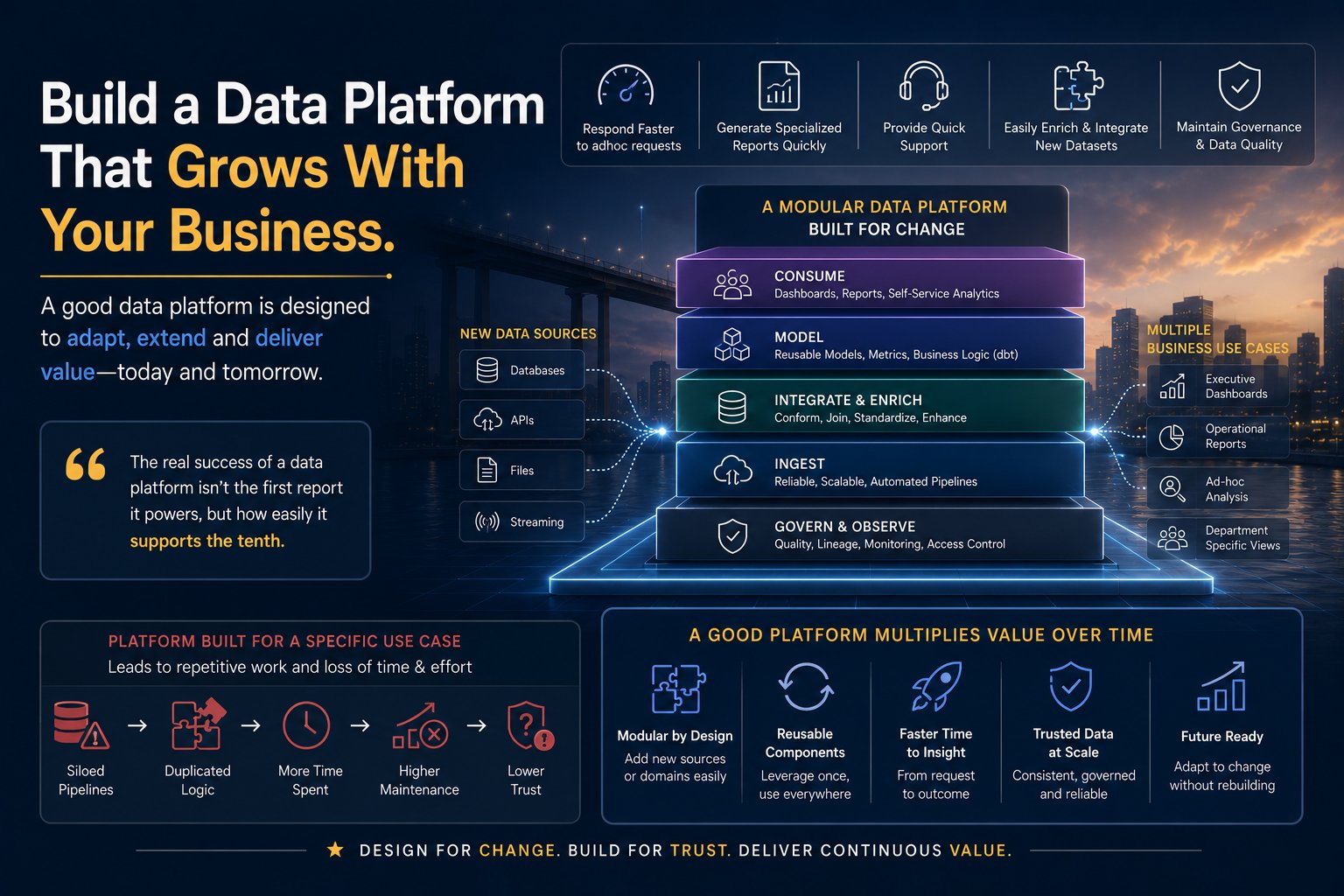
A data platform shouldn't just solve today's problem. It should make tomorrow's problem easier to solve.
One of the biggest misconceptions I see in data engineering is designing platforms around a single reporting requirement. A dashboard needs to be built. A finance report needs automation. A KPI needs to be calculated. So we build pipelines that solve exactly that problem. The report gets delivered. The project closes.
Then reality begins.
- A week later"Can we add another business unit?"
- A month later"Can we include a new data source?"
- A quarter later"Can we create an executive dashboard using the same data?"
Before long, the platform becomes a collection of one-off pipelines, duplicated business logic, and tightly coupled transformations. Every new request feels like a new project.
What a well-designed platform should make easy
I've learned that a well-designed data platform should be able to support far more than its original use case. It should make it easy to:
- Integrate new datasets without redesigning existing pipelines
- Support ad-hoc analytical requests without bypassing governance
- Generate specialized reports using reusable business logic
- Enrich existing datasets with minimal engineering effort
- Enable multiple teams to consume the same trusted data in different ways
The goal isn't to predict every future requirement. It's to design modularity, reusability, and extensibility into the platform from day one.
That's why architecture decisions like layered transformations, reusable semantic models, standardized dimensions, and clear ownership are far more valuable than simply delivering another pipeline. A data platform should become more valuable as new use cases are added — not more difficult to maintain.
The test
How do you know your platform is well architected? When adding a new business requirement feels like configuration, not re-engineering.